




In Oman, the question is no longer whether consumers will buy online, but rather to what extent e-commerce will become a natural part of daily economic life.
In just a few years, Omani e-commerce has transformed from a limited activity practiced by a handful of stores and platforms into a rapidly expanding market, intertwined with digital payments, logistics, e-marketing, entrepreneurship, SMEs and even the state's economic policy.
In an interview with the Observer, Rashid bin Abdullah al Shidhani, an economic researcher and analyst, stated that the role of e-commerce in the national economy is growing and complementary to other economic sectors, both the oil and non-oil.
He emphasised that e-commerce is a fundamental and crucial driver in supporting SMEs by reducing their operating costs and generating logistics-related job opportunities for job seekers, thus contributing to the development of a service-based economy that supports Oman's national economic system.
Al Shidhani also mentioned that the development of digital infrastructure and its application in financial payments will contribute to attracting more foreign investment into the technology sector in the Sultanate of Oman. However, he stressed the need to expand the Omani market to enable the e-commerce sector to achieve genuine growth through the electronic export of digital raw materials, rather than simply selling products and providing services online.
Al Shidhani added that artificial intelligence will transform e-commerce in the coming years, shifting it from a store that simply displays products to one that understands your needs by modifying algorithms to recognise consumer requirements. He pointed out that AI plays a crucial role in developing e-commerce and is an important factor in raising community awareness and helping combat cyberattacks, particularly those involving suspicious links.
What is noteworthy about the Omani experience is that the growth of e-commerce is no longer measured solely by the number of online stores, but rather by an integrated economic system encompassing licensing, payments, logistics, digital marketing, consumer protection, finance, data and cybersecurity.
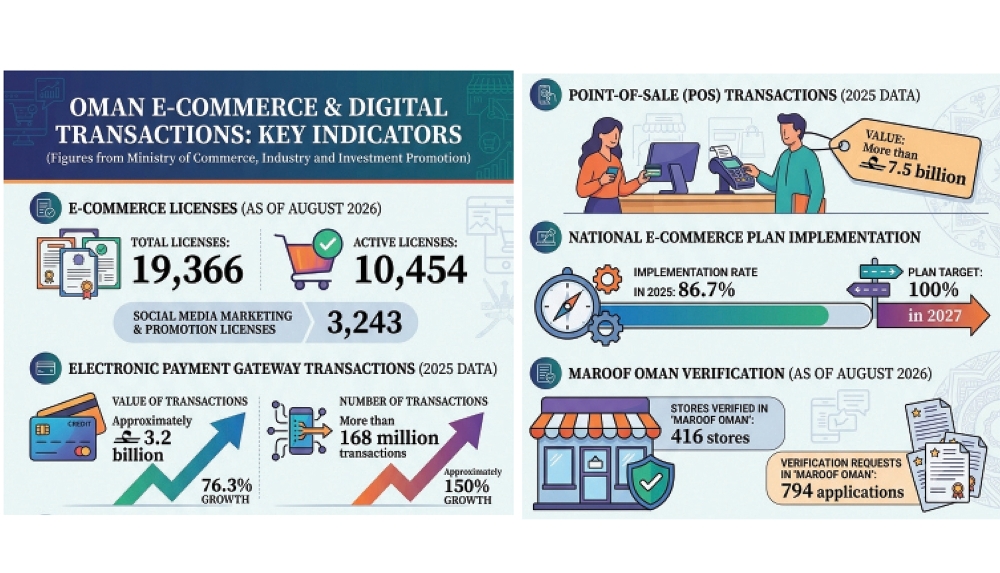
Official indicators suggest that e-commerce in the Sultanate of Oman has made significant strides in recent years. According to the Ministry of Commerce, Industry and Investment Promotion, the number of e-commerce licenses reached 19,366 as of August 2026. The Ministry also noted that the direct regulatory framework for e-commerce was significantly strengthened with the issuance of the E-Commerce Regulations under Ministerial Decision No 499/2023.
As of August of this year, Ministry data shows that the number of active e-commerce licenses has reached 10,454, in addition to 3,243 licenses for marketing and promotion activities via social media platforms. This reflects the expanding base of businesses that have come to rely on the internet and social media as effective channels for sales, marketing and reaching consumers.
Electronic payments: The clearest indicator of changing consumer behaviour
While the number of stores and licenses measures the supply side, electronic payments provide a clearer picture of the shift in demand and consumer behaviour. Transactions through local electronic payment gateways reached approximately RO 3.2 billion in 2025, marking a 76.3 per cent increase compared to 2024. While these figures do not represent the entirety of payments, as digital payments encompass various commercial and service activities, they do provide a significant indicator of the expanding infrastructure necessary for digital commerce and the Omani consumer's readiness to utilise cashless channels.
Despite the substantial growth in infrastructure, licensing and payment methods, consumer trust remains the most critical factor in the development of e-commerce.
In a traditional store, consumers can see the product, locate the seller and contact them if a problem arises. However, in the online environment, purchasing decisions are more heavily reliant on trust in the seller's identity, product quality, price transparency, payment methods, return policies, data protection and delivery speed.
Therefore, the Ministry has focused on developing regulatory and digital tools aimed at bridging the trust gap between consumers and online stores.
One of the most prominent of these tools is the "Maroof Oman" platform, which aims to verify licensed online stores, enabling consumers to check the legal status and information of the store, as well as facilitating feedback and communication between consumers and stores.
As of August, the platform had registered 416 online stores, while the number of verification requests reached 794. This step is of economic importance that extends beyond the regulatory aspect, as it helps transform trust from a personal relationship between seller and buyer to institutional trust based on licensing, verification and transparency.
Moving from regulation to market building
Over the past years, the Ministry has issued a wide range of decisions and regulations governing commercial activities, including e-commerce, marketing and promotion through websites and social media, as well as other activities related to the digital economy.
The e-commerce regulatory framework issued by Ministerial Decision No 499/2023 represents an important step in defining the framework within which sellers operate through websites and social media.
Nasra bint Sultan al Habsi, Director-General of Commerce at the Ministry of Commerce, Industry and Investment Promotion (MoCIIP), stated that e-commerce is one of the sectors most closely linked to continuous technological advancements. She added that the key to enforcing the law is not the platform used for sales, but whether the activity is a commercial activity subject to licensing and regulatory requirements. Using social media does not exempt the business owner from legal and regulatory obligations.
The Ministry indicates that the completion rate of the National E-Commerce Plan reached 86.7 per cent in 2025, following the completion of 26 out of 30 initiatives within the framework of government efforts to develop the digital business environment, with the goal of reaching 100 per cent completion by 2027. These figures indicate that the Sultanate has moved from the foundational stage to a more advanced stage of completing the system.
It is a mistake to view e-commerce as merely a new way to sell clothes, appliances, or food. Its impact extends to multiple economic sectors, including small and medium-sized enterprises (SMEs). SMEs are perhaps the biggest beneficiaries of e-commerce. Instead of needing a physical store in an expensive location, entrepreneurs can start their businesses online with less investment. This lowers barriers to entry and opens the door for home-based and small businesses to reach a wider audience. However, the reduced cost of entry also increases competition. This means that while e-commerce offers a greater opportunity, it doesn't guarantee success.
If Oman succeeds in building this model, e-commerce could transform from a consumer tool to an export tool, a shift that is economically crucial.
Available indicators show that Oman has moved beyond simply proving the importance of e-commerce and has entered a more critical phase: maximising its economic returns.
The increasing number of e-commerce licenses, the significant growth in digital payments, the expansion of government platforms, the high level of implementation of the National E-Commerce Plan, the development of the "Maroof Oman" platform and the modernisation of legislation all point to the formation of a more mature digital commerce ecosystem.
But the true test for the next phase will not be the number of online stores, but their ability to create added value, provide jobs, empower SMEs, increase exports and enhance the competitiveness of the Omani economy. The period from now until 2030 will be crucial in determining whether the Sultanate of Oman will be content with being a digital consumer market, or will become a regional hub capable of producing and exporting value through digital trade.
Oman Observer is now on the WhatsApp channel. Click here